One tennis court converts into four pickleball courts. That single fact has reshaped the economics of racquet sports in America. A facility that used to serve 4 players on one court can now serve 16 simultaneously in the same footprint. The Santa Monica Pickleball Center reported seven times as much revenue after converting from tennis. Across the country, converted facilities are seeing utilization rates between 75% and 92% — numbers most tennis operations never touched. Pickleball participation hit 19.8 million Americans in 2024, a 45.8% jump from the year before, and the infrastructure is still playing catch-up. The industry needs an estimated $855 million in new court construction just to meet current demand.
But here's the thing about indoor pickleball facilities: they have the cost structure of a gym and the inventory problem of an airline. Leases, HVAC, lighting, staffing, insurance — a 10-court indoor facility can easily run $10,000 to $100,000 a month in rent alone depending on the market, before you turn the lights on. And court time is perishable. An empty court at 2:30 PM on a Tuesday is revenue that's gone forever, same as an empty hotel room or an unsold airline seat. The hotel industry figured this out decades ago with revenue management — dynamic pricing, yield optimization, the whole discipline built around the idea that perishable inventory demands a different approach. Hotels track RevPAR (Revenue Per Available Room). Airlines track revenue per available seat mile. For court facilities, the equivalent metric is RevPACH — Revenue Per Available Court Hour. A 1% improvement in utilization at a 10-court facility charging $20/hour translates to roughly $18,000 in additional annual revenue. At scale, the booking experience isn't a nice-to-have — it's the revenue lever.
The data on checkout friction is unambiguous. Baymard Institute found that 18% of online shoppers abandon checkout because the process is too long, and forced account creation increases abandonment by 35%. On mobile — where most players are browsing — cart abandonment hits 85.65%. Stripe's research shows that Apple Pay increases checkout conversion by 22.3% on average, with some implementations seeing a 58% lift over traditional credit card forms. Every form field, every verification step, every redirect is a leak in the funnel. The average ecommerce checkout has 5.1 steps and 11.3 form fields. Baymard estimates that better checkout design alone could recover $260 billion in lost orders across US and EU ecommerce. The same physics apply to court booking — probably more so, because a $20 court reservation has a much lower commitment threshold than a $200 purchase, which means the tolerance for friction is even lower.
CourtReserve is the dominant platform in this space, serving over 2,000 facilities with scheduling, memberships, payments, events, and player communications. They recently secured $54 million in funding to scale the platform, and one of the first major features out of that investment is Public Booking — a flow that lets non-members reserve courts and register for events without creating an account. Clubs get a shareable link for their website, social media, Google Business listings, QR codes. Some early adopters saw up to $1,000 in new revenue in the first 30 days, with public bookings accounting for up to 13% of total court reservations. As Devan Egan from Club Pickleball USA put it: "We underestimated how many visitors wanted to book a court instantly. No calls, no accounts, no apps." That's demand that was already there but had nowhere frictionless to go.
We've been working on this same problem at Peak Time Pickleball in Charlotte. When we started building our booking system — we call it PickleGrid — the question wasn't just "how do we let guests book?" It was bigger: what does a player actually need to see before they commit to a court?
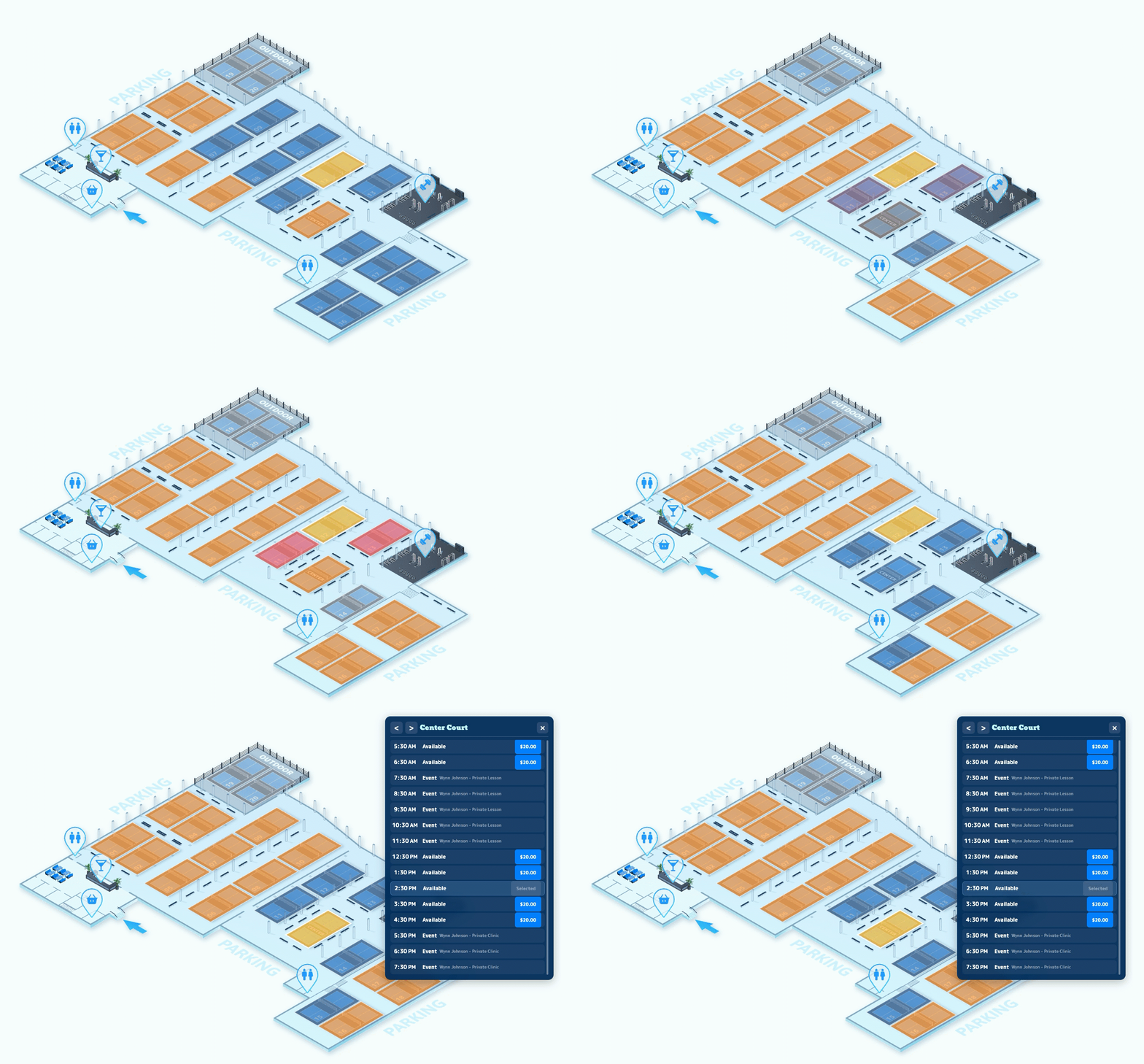
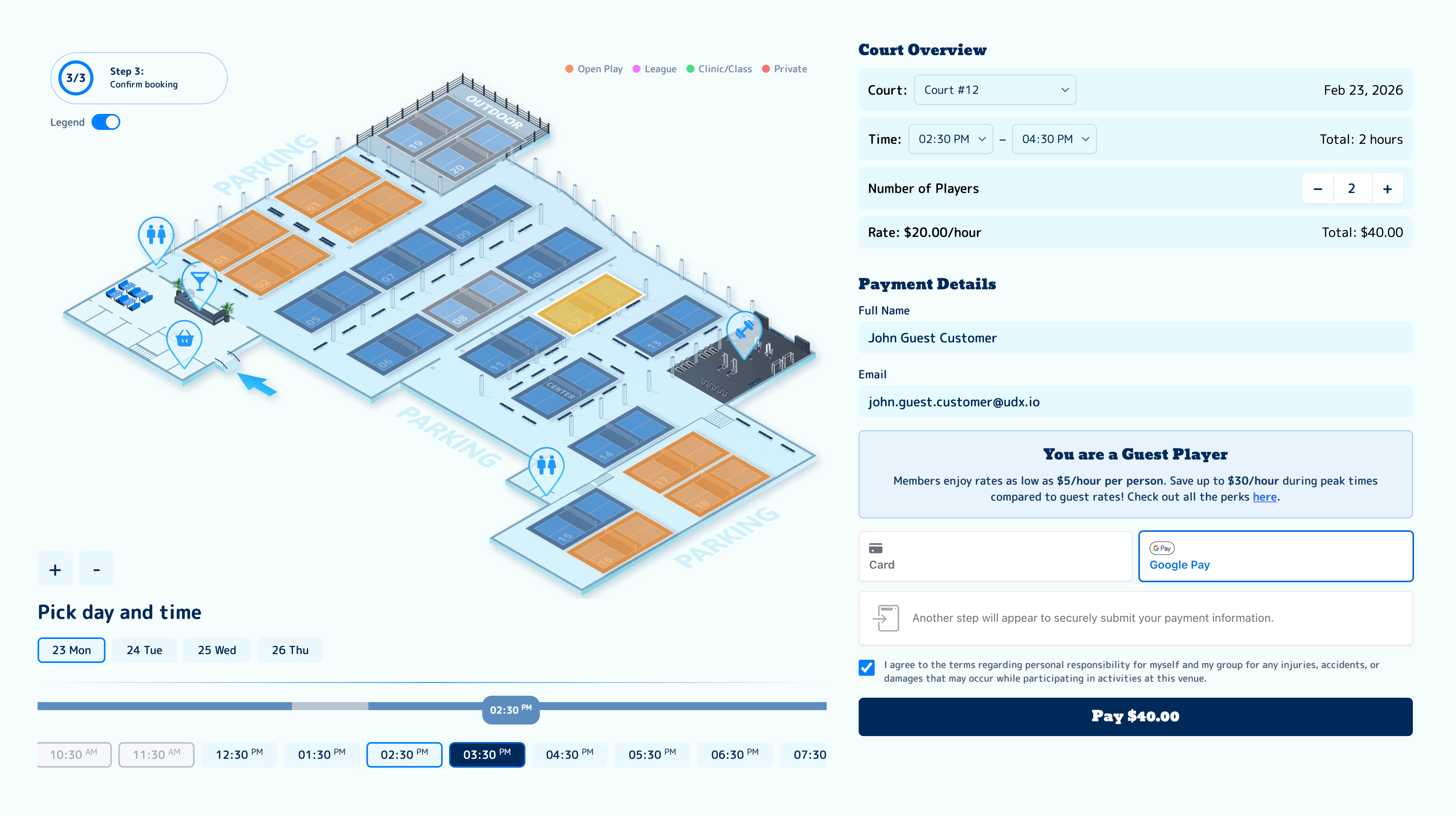
The answer turned out to be more than a list of available time slots. Research on visual booking interfaces shows that spatial context meaningfully impacts conversion — Booking.com attributes its industry-leading conversion rates partly to map-based search, and one hotel saw a 52% higher completion rate after switching to a visual calendar. When you land on our Book a Court page, you're looking at an isometric map of the entire facility. Every court is labeled. Every court is color-coded by what's happening on it — Open Play is orange, leagues are green, clinics and classes are teal, private bookings are red. You're not reading a grid. You're seeing the building. There's a time slider at the bottom that lets you scrub through the day and watch availability shift across all courts at once. Pair that with the day picker and you can scan an entire week in seconds.
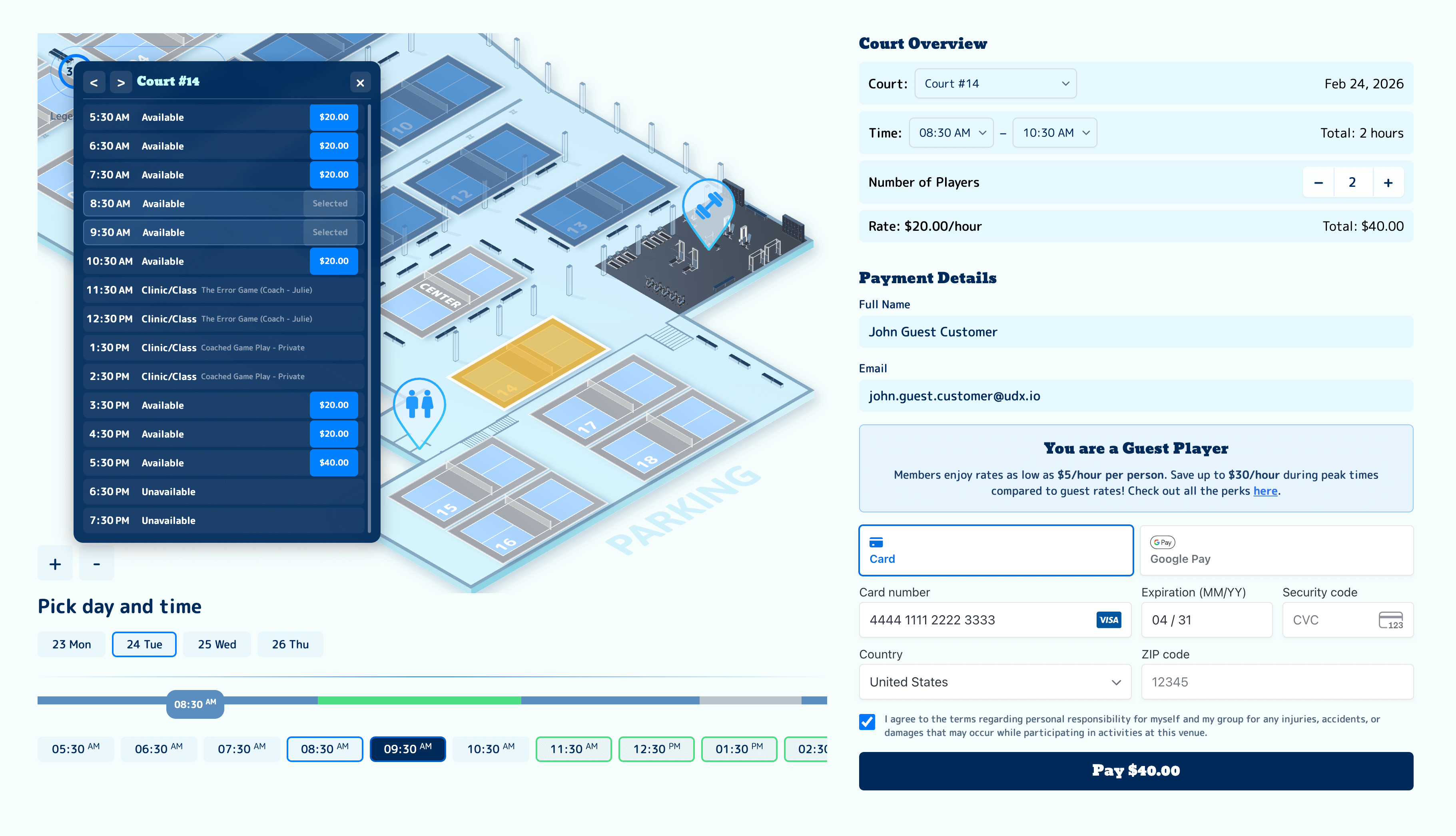
Double-click any court and a detail panel opens showing every slot for that day — what's available, what's booked, what type of activity is running, and the price for each slot. Prices shift based on demand. Peak hours cost more, off-peak costs less. You see all of it before you commit to anything. Nearly half of all shoppers bail when they encounter unexpected costs at checkout — we show you the price before you even start the booking process.
The part I'm most proud of is how we handle identity. There's no "log in or book as guest" fork in the road. Baymard found that 62% of sites fail to make guest checkout the most prominent option — we eliminated the choice entirely. Everyone lands on the same page. You pick your court, pick your time, enter your name and email. If you're a guest, the system shows you guest pricing — $20/hour — and a blue banner that says "You are a Guest Player" with a note about how much members save. Industry data shows guest-to-member conversion rates at sports facilities average 15-25%, and the best-performing facilities get there through low-friction exposure, not hard sells. Our banner is the upsell — visible, honest, not a gate.
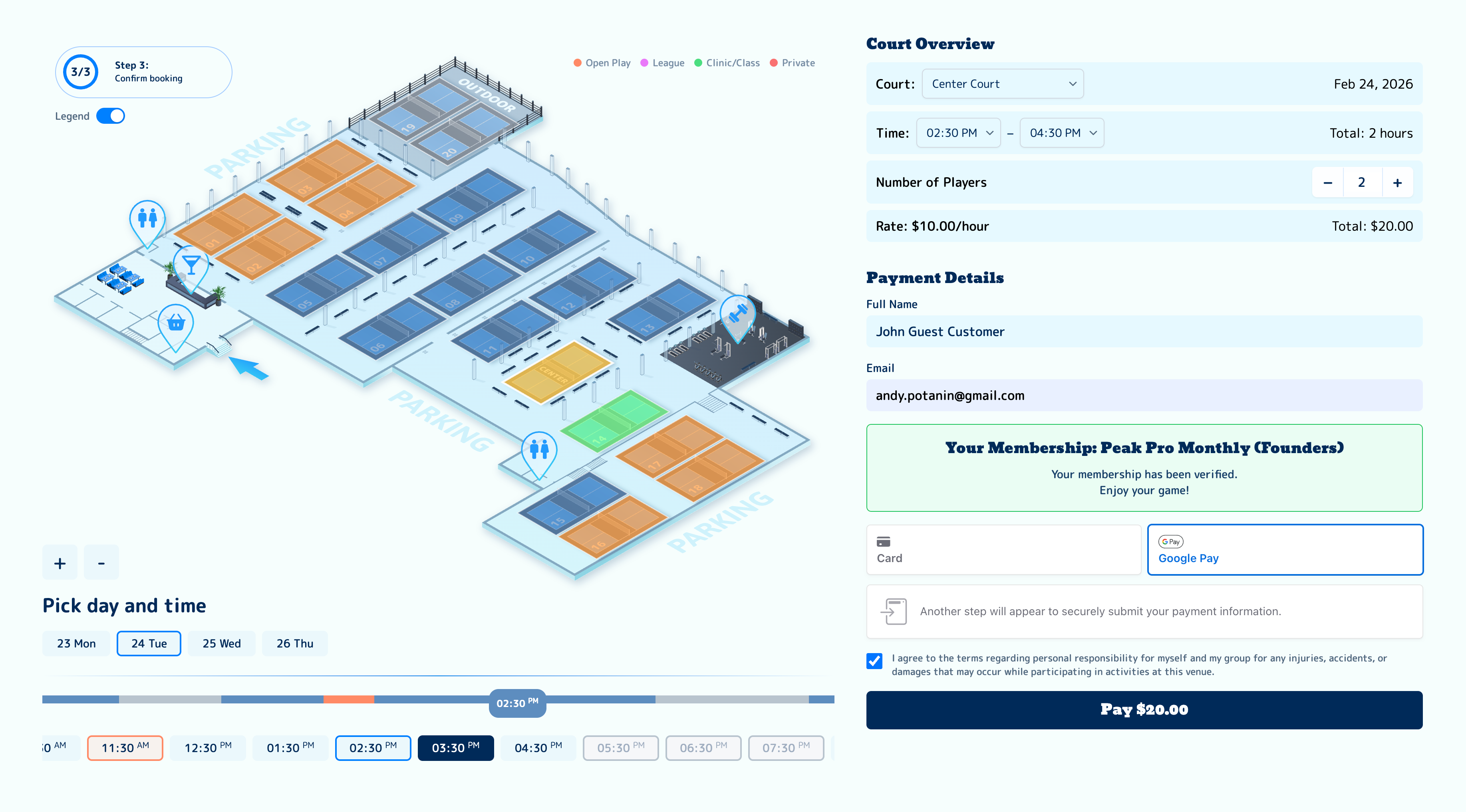
But if you enter an email associated with a membership, everything changes instantly. The banner turns green, confirms your membership tier, and the rate drops to $10/hour. No login. No password. No redirect. Same page, same flow. The system recognized you and adjusted pricing on the spot.
Payment is one step. We support Apple Pay, Google Pay, and credit card natively. Given that Apple Pay users complete transactions at a 50% rate compared to 30% for standard credit card forms — and check out 50% faster — one-tap payment on mobile isn't a nice-to-have. It's the difference between a booking and a bounce. A guest can tap Apple Pay and be done in under a minute. No phone number. No SMS verification code. No 15-minute countdown timer. The payment itself is the verification.
CourtReserve's Public Booking approach makes sense for their position. They're building for thousands of clubs with varying technical capabilities, so they optimize for security and broad compatibility. SMS verification ensures bookings are legitimate. A 15-minute payment window prevents abandoned holds. The hosted URL means any club can be live in minutes without touching their website. They also support event registration through the public flow — for clubs running clinics, leagues, and tournaments, letting non-members register and pay without an account is genuinely valuable. The custom confirmation page where clubs can add cancellation policies and parking instructions cuts down on post-booking support questions.
The difference comes down to what you're optimizing for. CourtReserve is raising the floor for clubs that previously had nothing — and for an industry that still needs 25,800 new courts, that matters enormously. We're trying to raise the ceiling for what a booking experience can feel like when you treat court time like the perishable, high-value inventory it actually is. When you're competing for attention with everything else on someone's phone, the experience is the marketing. Players want to see what's available, pick a spot, pay, and get on with their day. The closer we get to eliminating the steps between "I want to play" and "I have a court," the more courts get filled — and in a business where every empty court hour is gone forever, that's the whole game.